
What if there were a way to know whether the God of the Bible is really the one true God?
Nearly three thousand years ago, He issued a challenge.
“Present your case,” says the LORD. “Bring forward your strong arguments” (Isaiah 41:21).
It is the language of a courtroom. God summons every false god and demands evidence. His test is history itself: account for what has happened, then “declare the things that are going to come afterward” (Isaiah 41:23).
But God does more than challenge His rivals. He calls the ancient nation of Israel and her prophetic future to the witness stand:
“Have I not long since announced it to you and declared it? And you are My witnesses. Is there any God besides Me?” (Isaiah 44:8).
Then there is the challenge. God placed His ancient nation Israel on the witness stand as Exhibit A:
“But now listen, O Jacob, My servant, Israel, whom I have chosen… Who is like Me? Let him proclaim and declare it; yes, let him recount it to Me in order, from the time that I established the ancient nation. And let them declare to them the things that are coming and the events that are going to take place” (Isaiah 44:1, 7).
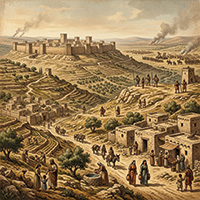 Israel does not merely possess God’s prophetic words. Israel’s existence and prophetic history stand as God’s irrefutable witness that He alone controls the future and reveals history in advance.
God states His claim unmistakably: “I am God, and there is no one like Me, declaring the end from the beginning” (Isaiah 46:9–10). And He explains why He announced scores of prophetic events beforehand: “Before they took place I proclaimed them to you, so that you would not say, ‘My idol has done them’” (Isaiah 48:5).
So let us take God up on His challenge. Let us recount the history in order.
ISRAEL — A HISTORY WRITTEN BEFORE IT HAPPENED
The story begins before there was a nation called Israel. God called Abraham and told him, “I will make you a great nation” (Genesis 12:2). Before his descendants possessed a country, the people had been identified.
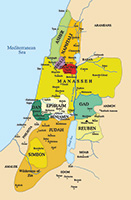 So had the land: “To your descendants I will give this land” (Genesis 12:7). Scripture had attached a particular family to a particular land.
Centuries later, before Israel entered that land as a nation, Moses warned that rebellion against His law would bring devastating consequences: “The LORD will scatter you among all peoples, from one end of the earth to the other” (Deuteronomy 28:64).
The land itself would bear the scars of judgment: “I will make the land desolate. … You, however, I will scatter among the nations” (Leviticus 26:32–33). Two related judgments: the people scattered and the land left desolate.
Yet dispersion would not mean disappearance. God declared that even in their enemies’ lands, “I will not reject them…so as to destroy them” (Leviticus 26:44). Jeremiah later said only if the fixed order of the sun, moon, and stars departed would Israel “cease from being a nation before Me forever” (Jeremiah 31:35–36).
Israel would be scattered—but not erased.
Then Hosea added one of the strangest features in the portrait: “The sons of Israel will remain for many days without king or prince, without sacrifice” (Hosea 3:4).
Many days. No throne. No altar. After Rome destroyed the Second Temple in A.D. 70, Israel was scattered and the sacrificial system ceased. Century followed century, yet the Jewish people remained identifiable.
But dispersion was not the end. Moses wrote that God would “gather you again from all the peoples” and “bring you into the land which your fathers possessed” (Deuteronomy 30:3, 5). Ezekiel compressed both movements into one sentence: “I will take you from the nations, gather you from all the lands and bring you into your own land” (Ezekiel 36:24).
From the nations. Back to the ancestral land. Both the source and the destination were written beforehand. And the desolate land would not stay desolate: “The desolate land will be cultivated,” and ruined cities would again be “fortified and inhabited” (Ezekiel 36:34–35).
Nearly eighteen centuries after Jerusalem fell to Rome, an unlikely eyewitness rode through what was historically referred to as Palestine. His name was Mark Twain. Traveling there in 1867 for what became The Innocents Abroad, Twain described Israel as a “desolate country,” a “silent, mournful expanse,” and later “a hopeless, dreary, heart-broken land.” He summarized his impression in six unforgettable words: “Palestine sits in sackcloth and ashes.”
Then came the remarkable reversal the prophets had also described. Jews returned from more than 150 countries across Europe, Africa, the Middle East, and beyond.
Ezekiel also prophesied concerning the reversal of Israel’s ancient division into the kingdoms of Judah and Israel. God told him to join two sticks representing the divided peoples, then explained: “I will make them one nation in the land…and they will no longer be two nations and no longer be divided into two kingdoms” (Ezekiel 37:22).
The returning people did not reappear as rival kingdoms of Judah and Israel. They stand together under one national name: Israel. This is precisely the test God gave His rivals: recount the history in order:
1. One family becomes a nation.
2. A particular land is assigned to that people.
3. The people are scattered among the nations.
4. The land becomes desolate.
5. The scattered people survive rather than disappear.
6. They endure “many days” without king or sacrifice.
7. They are gathered from many lands.
8. They return specifically to their ancestral land.
9. The desolate land is cultivated and its ruined cities inhabited.
10. Judah and Israel reappear as one nation rather than two rival kingdoms.
That is ten of many more identifiable prophetic markers.
SIXTEEN THOUSAND PEOPLES — ONE NAMED TARGET
Joshua Project identifies 16,000 distinct people groups in the world today. That is what makes the biblical focus on one named people so remarkable: Israel was singled out beforehand as the target of this unfolding pattern of prophecy and fulfillment.
Imagine an enormous stadium filled with representatives of more than sixteen thousand different peoples. One family is singled out by name. Before later stages arrive, the record fixes the outline of that family’s future: scattering, preservation, many days without king or sacrifice, regathering, a particular destination, and restoration of the land.
Scripture did not predict that something remarkable would happen to somebody. It named Abraham. It named Israel. It named the land.
Other peoples have experienced diaspora and return. What distinguishes Israel is the breathtaking sequence plus the fact that the Bible named Israel beforehand. One can try to imagine it is a colossal coincidence. But you will have to explain how the coincidence knew whose name to use.
YOU CAN LOOK AT THE INK
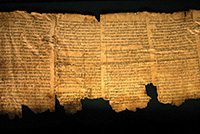 Among the Dead Sea Scrolls is the Great Isaiah Scroll, copied around 125 B.C., containing all sixty-six chapters of Isaiah in Hebrew. The Dead Sea Scrolls also preserve manuscripts and fragments from other biblical books cited here. You do not have to imagine the ink. You can look at it.
The prophecies of Isaiah were physically on the page before Jesus Christ was born, more than two thousand years before the modern State of Israel appeared.
But prophecy is not finished with Israel. Zechariah foretold a day when Jerusalem would become “a heavy stone for all the peoples” and the nations would gather against her (Zechariah 12:2–3). Today Jerusalem is the most fiercely contested piece of real estate on earth. Year after year, the UN General Assembly singles out the tiny nation of Israel with about twice as many condemnatory resolutions as all the other nations of the world combined.
Yet the prophecy of Zechariah reaches beyond the present conflict: God will intervene to save Jerusalem, and Israel will “look on Me whom they have pierced” and mourn for Him (Zechariah 12:10).
The nation. The city. And the pierced One. We have examined the witness. God’s question remains: “Is there any God besides Me?” (Isaiah 44:8).
Now stand in that stadium once more. This time prophecy narrows from one people to one Man—before His life unfolds.
Centuries before Jesus Christ came, the Old Testament prophets described the portrait. A ruler would come from Bethlehem (Micah 5:2), from the line of David (Jeremiah 23:5). He would enter Jerusalem as a King, humble and riding on a donkey (Zechariah 9:9), yet be despised and rejected (Isaiah 53:3).
Psalm 22 portrays the suffering Righteous One surrounded by mockers who hurl the very taunt later heard at Golgotha (verses 7–8), His hands and feet pierced (verse 16), while men divide His garments and cast lots for them (verse 18)—centuries before the crucifixion of Jesus. Isaiah adds that He would be “cut off out of the land of the living,” yet be with a rich man in His death (Isaiah 53:8–9).
Earlier, prophecy singled out Israel from thousands of peoples. Now the target narrows astonishingly further: out of the billions who would walk the earth, one Man would bear this prophetic fingerprint—David’s line, Bethlehem, Jerusalem, rejection, piercing, divided garments, and a rich man’s tomb. The markers did not scatter across history. They converged in Jesus Christ.
Many predictions. One Man. Jesus Christ. The ink was dry before the blood was shed.
About seven hundred years before Jesus was born, Isaiah had already prophesied:
“He was despised and forsaken of men.… But He was pierced through for our transgressions, He was crushed for our iniquities” (Isaiah 53:3, 5).
Until now, you have been examining the evidence. Isaiah 53 turns the question around. The prophecy now tells you why the Messiah suffered.
“He was pierced through for our transgressions.”
The word that changes everything is “our.”
Isaiah continues: “All of us like sheep have gone astray…but the LORD has caused the iniquity of us all to fall on Him” (verse 6).
That includes me. And it includes you.
We have not merely made mistakes. We have sinned against the God who made us. We have lied, lusted, coveted, harbored hatred, used God’s holy name in vain, and placed ourselves on the throne that belongs to Him. Jesus said the greatest commandment is to love God with all our heart, soul, mind, and strength. Not one of us has done that for a single day.
If God opened the record of your life and judged you by it, would you be innocent?
The same God who declares the end from the beginning has already written your appointment:
“It is appointed for men to die once and after this comes judgment” (Hebrews 9:27).
Death is not an escape. John saw the dead standing before God’s great white throne to be judged, and anyone whose name was not found in the Book of Life was thrown into the lake of fire (Revelation 20:11–15).
Religion, good works, excuses, and promises to do better cannot erase your guilt before God. You will stand before the living God who knows you completely and whose laws you have broken.
That is why the pierced One came. Jesus Christ, the Son of God, lived without sin—the life we have not lived—and willingly went to a cross He did not deserve. There He bore the penalty for our sins and endured the judgment we deserved.
At the cross, history caught up with the words: “The LORD has caused the iniquity of us all to fall on Him.” He died. He was buried. And on the third day Jesus Christ rose bodily from the dead.
The One who entered death conquered it. Jesus declared, “I was dead, and behold, I am alive forevermore, and I have the keys of death and of Hades” (Revelation 1:18).
The Judge before whom you will stand is the Savior who died so that you could be forgiven.
But forgiveness is not automatic. God “is now declaring to men that all people everywhere should repent” (Acts 17:30). Turn from sin and self-rule toward God. Stop trusting your own self-righteousness, your religion, or the illusion that you can earn God’s favor. Place your faith in Jesus Christ, who died for your sins and rose from the dead.
Jesus promised, “He who hears My word, and believes Him who sent Me, has eternal life, and does not come into judgment, but has passed out of death into life” (John 5:24).
Read those words again: “does not come into judgment,” but “has passed out of death into life.”
We began with a question: Can the God of the Bible really tell the end from the beginning? Look at the witness. The future of Israel was written. The suffering of the Messiah was written. And the judgment before which you will stand has been written. You will die. You will face the living God. But you do not have to face Him in your sins. You can be forgiven. Right now.
Turn to Jesus Christ while mercy is still being offered. Repent and trust the Savior who died for your sins and rose again. Follow Him. Receive the eternal life He alone can give.
“The one who comes to Me I will certainly not cast out.” —Jesus (John 6:37)
For His glory,
Pastor Joe Schimmel